

“I know, thanks” – The Earned Dogmatism Effect

Dogma, in the broad sense, is any belief held unquestioningly and with undefended certainty. It’s a point of view that people are expected to accept because it is put forth as authoritative without adequate grounds. This helps us understand more about the ‘Earned Dogmatism Effect‘ – which tells us that being labeled as an “expert” may contribute to us being close-minded.

In a study with six experiments, Victor Ottati, Erika D. Price, Chase Wilson from Loyola University Chicago and Nathanael Sumaktoyo from University of Notre Dame tested the Earned Dogmatism Hypothesis, and concluded that experts are entitled to adopt a relatively dogmatic, closed-minded orientation. As a consequence, situations that engender self-perceptions of high expertise elicit a more closed-minded cognitive style.

Inflated Scores

In one of the tests, participants were randomly assigned to the easy (successful) or difficult (failure) political test. Fifteen multiple choice questions were asked, with questions in the easy condition being, “Who is the current President of the United States?“, to equivalent question in the difficult condition being “Who was Nixon’s initial Vice-President?“.

Upon completing the test, participants were provided with false and inflated scores. Participants in the easy (successful) condition were told that they performed better than 86% of the other test takers; whereas participants in the difficult (failure) condition were told they performed worse than 86% of the test takers.

The participants in the difficult (failure) condition expressed greater political open mindedness than those in the easy (successful) condition. This went on the prove that even the higher self-perceived expertise created an effect of cognition blockade into themselves. Those people who had the impression that they were relatively expert on a certain topic (even when they were given inflated scores), led them to be less willing to consider others’ viewpoints – as stated by this earned dogmatism effect.

President Obama’s Policies

In another test conducted by Ottari and team, participants were asked to enlist either two (easy case) or ten (difficult case) policies implemented by the then US President, Barack Obama. Participants were randomly assigned to the easy or difficult case. In the easy case, participants were allowed to advance to next screen as long as they described one policy. In the difficult case, the participants were asked to write ten policies signed by Obama, or if they couldn’t name ten, they were instructed to write “I don’t know” in the remaining text boxes.

The result? All participants in the easy condition named at least one policy and more than half of the participants named two policies. In the difficult condition, participants named an average of four policies. As predicted by the Earned Dogmatism Effect, participants in the difficult condition reported greater openness to political open mindedness, while participants in the easy condition had less openness to other political opinions.

The Conundrum of Confidence & Competence

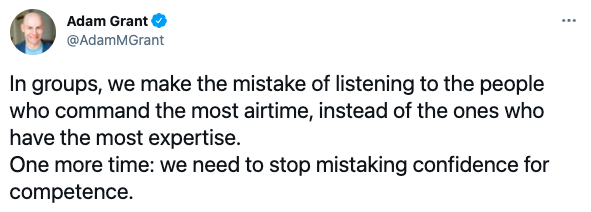
The top rated professor at Wharton for seven straight years, Adam Grant, says, “We need to stop mistaking confidence for competence.

The problem is that we equate confidence with competence. But they’re very different things. Unjustified confidence is a form of incompetence, and likewise, competence doesn’t really justify the confidence.
The Earned Dogmatism Effect - Confidence vs Competence

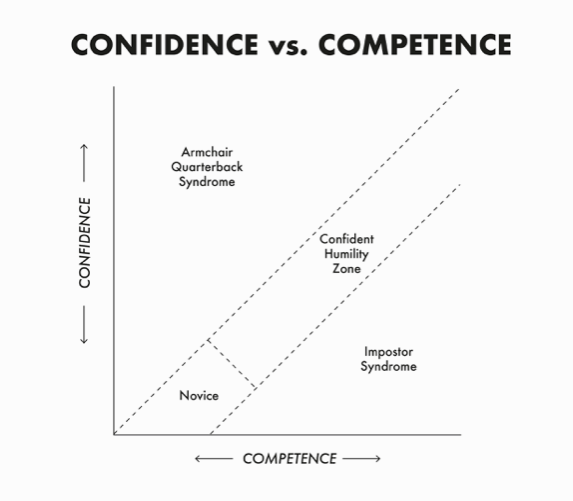
In Grant’s recently published book, “Think Again“, he describes two major syndromes – armchair quarterback syndrome and imposter syndrome – with the difference of these two things – competence and confidence.

When confidence is greater than competence, we fall victim of armchair quarterback syndrome, when we become blind to our own weakness. The opposite of armchair quarterback syndrome, imposter syndrome, is where competence exceeds confidence.

So where do we begin then?

In between the two syndromes, we have the sweet spot of confident humility zone. The right balance between competence as well as confidence brings out the best within us, allowing us to dodge the tricky earned dogmatism effect.
The Earned Dogmatism Effect - Confidence vs Competence
Confidence vs Competence, Adapted from Adam Grant’s book “Think Again”

No one likes an arrogant expert. Being definite, confident, and certain are all good things for conveying competence, but being dogmatic, narrow, and inflexible can limit the credibility and usefulness of the expert. 

To start with, we need to think deliberately how we can be wrong. Of course it is hard for our biased brain to scan our wrongness ourselves. To avoid such biases, we can reframe the question as, “How can others be right?“. Asking the question would not really prevent us from escaping our wrongness, but helps to understand a different perspective where two rights can exist.

Countless studies have shown that most of us overestimate our understanding of various topics, everything from how a vacuum cleaner works to the detail of political policies – a phenomenon explained by ‘the illusion of explanatory depth’. It is essential for us to understand and establish a realistic sense of our own knowledge. A simple way to address this intellectual overconfidence is to make the effort to explain a relevant issue or topic to yourself or someone else in detail, either out loud or in writing. This exercise makes us aware about the gaps in our knowledge, making it more apparent, thereby breaking this illusion of expertise.

To understand another way to combat our illusion of expertise, we need to explore one of the mental models given by Josh Waitzkin, a chess prodigy and an author of the book, “The Art of Learning“. Waitzkin tells:

It’s so easy to think that we were in the dark yesterday but we’re in the light today… but we’re in the dark today too.

Josh Waitzkin, author, “The Art of Learning

The same way we look back at five years younger ourselves and laugh about how stupid we were, we will definitely look back at today five years from now and laugh again. We commonly go on to say, “I didn’t know before, but I know today”. This only tells us that we don’t know something today as well, which we will know tomorrow. This realization will definitely help us to break the illusion, and come above the earned dogmatism effect.

In conclusion, the next time your back of the head tells you during a conversation, “I know, thanks”, tell the biased brain, “You don’t know everything, so let me listen.”

Also read: Where even experts can go wrong?

Towards Equanimity

Disclaimer: I am – by no means – an expert in equanimity, and this article only represents the tips I have been practicing on my own.


equanimity
/ˌɛkwəˈnɪmɪti,ˌiːkwəˈnɪmɪti/
noun
calmness and composure, especially in a difficult situation.


Our life is full of problems, conflicts, and crises – be it at work, home, or in relationship. From forgetting an anniversary to homelocked in quarantine during a global pandemic, stress has surrounded our lives. In times like these, most of us – we panic. And we stress even more.

However, we see some people find it easy to navigate around stress. Some people deal with conflicts with some impressive calmness. We don’t even see a slight flinch in their responses. How do people gain such composure even in adversity? This question hit me hard. I decided to explore. I vowed to become one of such people. I’ll tell you what I’m doing so far, but let’s first understand the concept of equanimity.

What actually is Equanimity?

Equanimity – by its definition – might sound like mindfulness. But it’s not. It’s moving beyond mindfulness. This article from Mindfulness journal speaks more about what equanimity is, and has addressed it as follows:

In the Buddhist tradition, the term “equanimity” (upeksha in Sanskrit, upekkha in Pali) is a complex construct that has been given multiple definitions along the development of Buddhist thought. At its heart is the word for ‘eye’ and ‘see’, with a prefix suggesting ‘gazing upon’ or observing without interference. It is “a state of mind that cannot be swayed by biases and preferences”, an “even-mindedness in the face of every sort of experience, regardless of whether pleasure [or] pain are present or not”. This state of equanimity manifests as “a balanced reaction to joy and misery, which protects one from emotional agitation”.

Equanimity is the capacity to remain neutral, to observe from a distance and be at peace without getting caught up in what we observe. It’s the capacity to see the big picture with understanding. In essence, it is about taking nothing personally, refusing to get caught up in the drama – either our own or others’.

Equanimity is the foundation for wisdom and freedom and for compassion and love. It is not, as some have mistaken, a “dryness,” coolness, indifference or aloofness. It is not the suppression of feelings, apathy or inexpressiveness. Equanimity is not indifference.

Equanimity also involves a level of impartiality (i.e, being not partial or biased), such that one can experience unpleasant thoughts or emotions without repressing, denying, judging, or having aversion for them. Similarly, in a state of equanimity one can have pleasant or rewarding experiences without becoming over-excited (e.g., to the point of mania or hypomania), or trying to prolong these experiences, or becoming addicted to them.

Practicing Equanimity

To begin understanding about practicing equanimity, let us understand this verse from the Bhagavad Gita first:

योगस्थ: कुरु कर्माणि सङ्गं त्यक्त्वा धनञ्जय |
सिद्ध्यसिद्ध्यो: समो भूत्वा समत्वं योग उच्यते ||

yoga-sthaḥ kuru karmāṇi saṅgaṁ tyaktvā dhanañjaya
siddhy-asiddhyoḥ samo bhūtvā samatvaṁ yoga uchyate

Translation: Be steadfast in the performance of your duty, O Arjun, abandoning attachment to success and failure. Such equanimity is called Yog.

Equanimity Step 1: Our feelings aren’t us.

Practicing equanimity requires us to remain equipoised in the face of joy or sorrow, and such balanced reaction will protect us from emotional agitation. As Harvard Medical School’s psychologist Susan David, PhD says, “When we identify with an emotion too closely, we often describe it as if it defines us.” A space between us and our emotions is required for clarity. Dr. David further recommends us not to say “I am sad”, or “I am anxious”. Instead, we should try to notice the feeling for what it is – “I am feeling sad”, or “I am noticing that I’m feeling worried”.

Understanding this becomes crucial to avoid reacting emotionally. To get better at this, my good friends Sagar, AJ & team of My Emotions Matter (MEM) recommends separating facts from feelings. Here are some examples from team MEM on separating facts and feelings:

Feeling: You ignored me.
Fact: You haven’t replied to my message for 10 days.

Feeling: I’m worthless.
Fact: I didn’t pass my exam.

Separating facts and feelings allows us to refrain from labeling, judging, or diagnosing any person, object, or event. This allows us to objectively view the incident without falling prey to any cognitive biases. The Indian philosopher Krishnamurti accurately remarked, “The highest form of intelligence is the ability to observe without evaluating.

Equanimity Step 2: We need to manage our response to our feelings.

Meditator, writer, and speaker Yung Pueblo mentions, “It is not about managing your emotions, it is about managing your reaction to your emotions.”

“Reactions give us the clearest view of what our mind experienced in the past, they are the dense patterns that rise from the deep subconscious as a way to protect us. This form of defense is not based on wisdom, but on survival, when we start expanding our self-awareness, especially during moments of turbulence, we start to see that we have more effective options than just repeating blind behaviors, which produce limited results that generally wipe away our clarity and inner peace in the process.”
– Yung Pueblo

We manage our reactions not by controlling them but by bringing awareness into the process — it is hard to change if you cannot see yourself.

Equanimity Step 3: Developing stoic resiliency.

It’s not events that upset us but rather our opinions about them.

— Epictetus, Stoic philosopher

Equanimity is the central concept in Stoic ethics and psychology. The Greek stoics used the word “Apatheia” (from a- “without” and pathos “suffering” or “passion”), which referred to a state of mind in which one is not disturbed by the passions. Equanimity is closely related to multiple religions – in Hinduism as Samatvam, in Buddhism and Yoga as Upeksha, in Judaism as Menuhat ha-Nefesh or Yishuv ha-Da’at, in Islam as Aslama; and has been used as a core principle in multiple philosophies – in Pyrrhonism (as ataraxia), Taoism, Stoicism, and Epicureanism.

Stoic philosopher Epictetus mentioned that the chief task in life is simply to identify and separate matters so that one can clearly segregate which are externals not under their control, and which have to do with the choices one can actually control. Roman emperor and stoic philosopher Marcus Aurelius also mentioned, “You have power over your mind-not outside events. Realize this, and you will find strength“.

Holocaust survivor and prominent Viennese psychiatrist, Viktor E. Frankl’s most enduring insight has been derived from this philosophy of stoicism – “You cannot control what happens to you in life, but you can always control what you will feel and do about what happens to you”. Forces beyond our control can take away everything we possess except one thing, our freedom to choose how we will respond to the situation.

The ability to reason, take a perspective from outside of the situation, and hold ourselves accountable are ways that the Stoics would have laid the foundation on building resiliency in one’s’ life.

No person has the power to have everything they want, but it is in their power not to want what they don’t have, and to cheerfully put to good use what they do have.

— Seneca

To sum up the resiliency from the Stoics, focus on two principles – i) Events are neither good nor bad, but it’s our own interpretation of them that is good or bad, and ii) what lies within our sphere of control and what lies beyond it. The trifecta for change suggests being aware of these two principles as a foundation for building resilience, and practicing equanimity. The second stage is to accept that whatever we are doing, we take the full responsibility. No one else is responsible for what we think, feel, or act except us ourselves. And finally, the third stage is to act. During the act, it is essential we ask ourselves – “Is what I am doing helping or harming me?”

Again, let us be reminded that our actions are within our control, but the results are not. As organizational psychologist, Adam Grant once mentioned, “Satisfying work is about enjoying the process, not the product. Pride in the result is not a substitute for joy in creating it.”

This brings us back to the Bhagavad Gita verse mentioned above. When we can perform any act to the best of our ability, abandoning worries and attachment to results, and remain equipoised, then we can say we are in the path towards equanimity.


Read Next : Lazy Humans & Principle of Least Effort [Popular]

The Diagnosis Pitfall : How even experts can fall in it?

The Diagnosis Pitfall

A woman – visibly in panic and grief – runs into the emergency room with her two years old daughter, who was experiencing severe stomach pains.

Normally, the ER (Emergency Room) doctor & the team would have started running tests for diagnostics. However, in this particular case, the ER doctors shifted their attention from the two-year old daughter to the mother, because the mother appeared to be overly concerned and seemed like a parent who would overreact. The doctors sent the mother-daughter home, dismissing any signs of impending severe dangers.

The woman returned the next day. While the ER doctors know how vital it is to carefully listen to the parents while treating infants, the doctors were now even more justified that the woman was overreacting, and labeled her as “hypochondriac”. Once again, the ER doctors sent them home, without proper tests and diagnosis.

The third day – the woman is back at the hospital with her daughter. It was only when the toddler lost consciousness, the doctors realized something was terribly wrong; but by then, it was already too late to save the precious life of the two-year old.

The moment the ER doctors labeled the mother “hypochondriac”, they fell into this pitfall of “Diagnosis Pitfall”, or “Diagnosis Bias”.

(Story adapted from Ori & Rom Brafman’s “Sway: The Irresistible Pull of Irrational Behavior”)

How can skilled, educated, and experienced doctors & physicians make such a disturbing decision? They go through years of rigorous training and intense practises because they’re responsible of saving someone’s life. But is it possible that even these knowledgeable doctors & physicians fall into the diagnosis pitfall?

Turns out, they can.

They’re humans after all. And our reliance on our cognitive process is vulnerable to biases, which makes treatment and diagnosis errors more likely than we think.

The journal article from Jill G Klein (associate professor of Marketing at INSEAD) published in the British Medical Journal (BMJ) explains about the five pitfalls in decision making about diagnosing and prescribing. The five common pitfalls are – i) Representative Heuristic, ii) Availability Heuristic, iii) Overconfidence, iv) Confirmation Bias, and v) Illusory Correlation.

Studies based on both simulated cases and questionnaires show that doctors are susceptible to decision making biases, including insensitivity to known probabilities, overconfidence, a failure to consider other options, the attraction effect, and the availability heuristic. The good news is that training in these dangers can reduce the probability of flawed medical decision making.

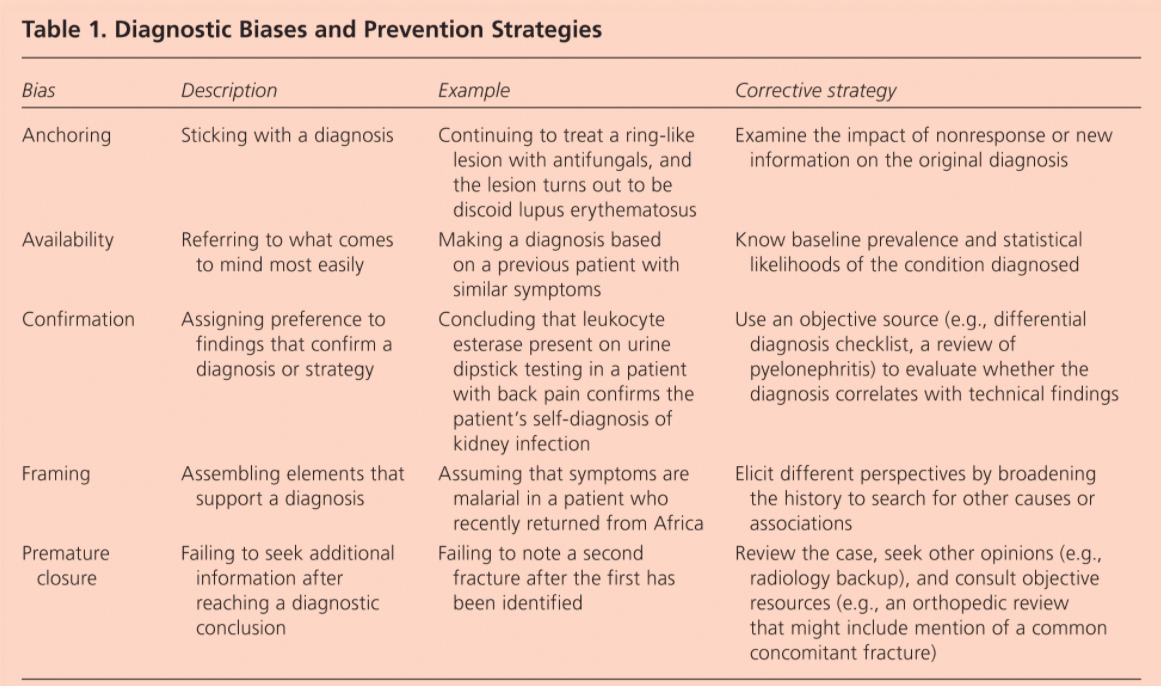
Caroline Wellbery, MD from Georgetown University School of Medicine, Washington, District of Columbia explains in her paper about the diagnostic bias and prevention strategies.

Diagnosis Pitfall

For a list and explanation about 50 various cognitive and affective biases in medicine, click here.

The Diagnosis Pitfall : How do you fall in?

In the above story, the doctors fell into the diagnosis pitfall in the moment they labeled the patient as “hypochondriac”.

When we label a person or situation, we put blinders to all evidence that contradicts our diagnosis. The “experts” at times are blinded by their past experiences, and could be fixated on the new event being the same as their past events. This happens to all of us. When we tend to selectively focus only on a part of the event that triggers our inner advice monster, we succumb into this trap of diagnosis pitfall. When we listen to someone sharing their story, and a part of it resembles our past event, we quickly prescribe them what had worked for us without realizing their situation might be completely new.

“When we tend to selectively focus only on a part of the event that triggers our inner advice monster, we succumb into this trap of diagnosis pitfall.”

There are usually three parts in falling prey to this biasness, viz. i) selective focus, ii) awakening inner advice monster, and iii) putting blinders to evidences that contradicts our diagnosis. Selective focus is when we tend to pick up only the selected event that resembles our past experiences and then zone-out the rest. Then, we subconsciously awaken our inner advice monster to prescribe what worked for us in the past, and finally, we do not look up enough evidences and factors that can contradict the advice we are about to prescribe.

The Diagnosis Pitfall : How do you get out?

To overcome this diagnosis, we need to understand how we get in first. Once we understand the “getting in” part, we can become aware of this dangerous pitfall, and the cost of this pitfall could be catastrophic. Being aware of our cognitive biases is the step one of overcoming any biases.

Second, understanding the three steps of falling prey to the diagnosis pitfall is essential. The answer to “getting out” of this pitfall is hidden in the route to “getting in” this pitfall. To overcome selective focus, we need conscious and empathic listening. When someone is sharing their situation, it’s not only the words that we should be paying attention to. Empathic listening is about letting the speaker know that we are genuinely interested in listening to them, we understand their problem as well as how they feel about it.

Taming the inner advice monster could be hard, but not impossible at all. To tame our advice monster, what we want to do is replace our advice-giving habit with a new habit: Staying curious. It’s as simple — and as difficult — as that.

Only when we have listened empathetically and not awakened our inner advice monster in between, we can then finally look for prescriptions. However, we should also be aware to look out for evidences that contradicts our prescriptions. In addition to vouching for “how this advice could work for you because it worked for me”, we should also seek to answer “how this advice could not work for you”.

Each person and each situation is different. Therefore, practicing a beginner’s mindset – or “shoshin” – could be crucial to overcome this pitfall. As Dr. Tracy Ochester (author of ‘Attitudes of Mindfulness: Beginner’s Mind’) puts it, “when we adopt the mind of a beginner, we endeavor to look at things as if for the first time, free from the influence of the past or speculation about the future. We open ourselves to what is here now, rather than constructing stories about what we think is here”.

Read Next: Don’t think outside the box

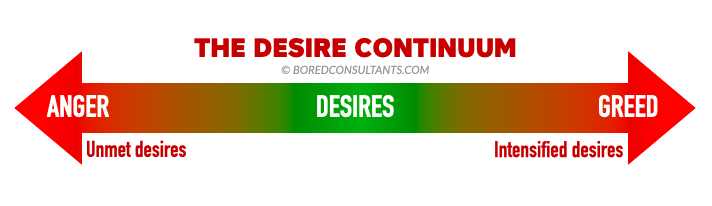
The Desire Continuum

The actions we take are the results of either conscious or sub-conscious desires deep-rooted within us. As Anthony Robbins says, “All communication is either a loving response or a cry for help“, our behaviors – including our communication – are guided by our needs and desires. Some desires are met, and some remains unmet. This stretching continuum shows us our own “Desire Continuum“, which could be a useful tool to build our self-awareness.

When our desires are continually met, we start desiring more. After all, human wants and needs are unlimited. When we’re not mindful about what we have in our possession, we tend to shift more to the ‘Greed‘ side of the desire continuum. We would simply want more – possessions, belonging, power, affiliation – just more of anything.

Contrary to it, when our desires are continually unmet, we tend to shift more to the ‘Anger‘ side of the desire continuum. When we don’t get what we desire for long, frustrations and anger starts kicking in, which would eventually cloud our judgement towards anything.

Desire Continuum

The Origin – Desire Continuum

काम एष क्रोध एष रजोगुणसमुद्भव: ।
महाशनो महापाप्मा विद्ध्येनमिह वैरिणम् ।।

Chapter 3, Verse 37 of the Bhagavad Gita translates into: The Supreme Lord said: It is lust alone, which is born of contact with the mode of passion, and later transformed into anger. Know this as the sinful, all-devouring enemy in the world.

While the Bhagavad Gita puts both greed and anger as our enemy, we could be more mindful of our own desires – and its swing to either left or right of the desire continuum.

Also Read: Don’t be yourself, consider adaptive authenticity

Self-Reflection questions to ask ourselves:

  1. What are our immediate desire(s)?
  2. What would be our long-term desire(s)?
  3. Are our desire(s) being unmet or intensified?
  4. If we get angry easily, what are our desire(s) that is unmet?
  5. What do we usually ‘greed‘ about?
  6. Do we notice any trend of intensified desire(s) in ourselves?
  7. What triggers do we notice in context to our desire(s) being met or unmet?

Answering these questions might not be the end, but it sure is a part of an enhanced self-aware journey.

Happy Dashain 2077, everyone!

Lazy Humans & Principle of Least Effort

Why do people just leave their partners in relationship rather than working and solving the differences? Why do people make excuses rather than taking accountability of their own works? Why do people assume things rather than communicating and comprehending? Turns out, the answer to all these human behaviors can be explained by one profound law – “The Principle of Least Effort“, among other possible factors.

What is Principle of Least Effort?

In 2004, Zao Liu and Zheng Ye (Lan) Yang conducted a study to understand the Texas A&M distance learning graduate students’ preference for seeking library resources, and the reason behind those preferences. The conclusion found that – no brainer – the Internet was the most used, while libraries were the next most used resource for conducting class research. The study found that the Principle of Least Effort was the primary behavior model of the most distance learning students, because of their strong preference towards easy and fast information retrieval.

This is what Principle of Least Effort is all about. In pursuit of reaching from point A to point B, humans will mostly choose the path where the least effort is required.

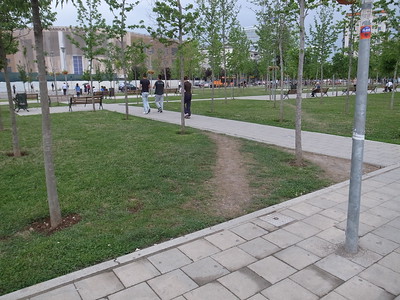
Principle of Least Effort

In this image, the desired path – the trail created on the grass – reflects best about this behavior of humans. Even though there doesn’t seem to be significant time saving while going by or around the pole stuck in the middle of the walking path, humans will evidently choose to go diagonal and walk forward and take a 90-degree turn (well, thanks to Pythagoras too!).

Human Behavior & Principle of Least Effort

So how does this Principle of Least Effort reflect in human behaviors?

Known as a “deterministic description of human behavior”, this principle applies largely on day to day human behaviors. As long as the work gets done or the result is achieved, humans will resort to using least of their efforts.

For instance, when we would need a certain clarification about our new diet plans, we would want to reach out and ask a dietician specialist. However, if we have someone generalist nutritionist nearby us, we would prefer to consult the generalist near to us than reaching out to the specialist three blocks away, as long as the generalist’s answers are within the threshold of acceptability.

Similarly, let’s say we want to listen to one of our favorite songs. Rather than reaching to our phone, unlocking it, opening the music app, searching for the song and then playing it, a lot easier work would be to summon Siri (or any other voice assistant) and ask it to play the song. The result is the same – the favorite song is played, but the steps and efforts to reach it is drastically different.

Ever wondered why the language has changed to chat vocabulary? “I’m rolling on the floor laughing” has become “ROFL“, “want to” has become “wanna“, “going to” has become “gonna“, “mathematics” has become “math“, “airplane” has become “plane“, and even “vocabulary” has become “vocab“. These language changes are also explained by the same principle, because speakers simplify their speech in various ways.

I’ve heard people claim they downloaded an app to turn off their TV while they were comfortably warm on their bed rather than getting up and looking for the TV’s actual remote. Genius! Result achieved with minimal effort – i.e. Principle of Least Effort.

Using Principle of Least Effort to our Advantage

Understanding this principle tells why people seem like they’re lazy, while they’re not actually lazy. They merely do things that are considered or labeled as lazy.

Let’s understand, our brains need energy to run. Computers are powered by either AC or DC current, while automobiles are powered by petrol, diesel, or electricity. Unlike these machines, our brains don’t have those sources of current to power on. Our brain is dependent on sugar as its main fuel. Glucose, a form of sugar, is the primary source of energy for every cell in the body. Because the brain is so rich in nerve cells, or neurons, it is the most energy-demanding organ, using one-half of all the sugar energy in the body.

Therefore, our brains need to conserve energy, and it does so by achieving results and getting work done with lowest possible efforts. If you remember why you felt drained and fatigue by focusing on those numbers and spreadsheets for one hour, this is because your brain used up a lot of energy.

Also Read: Rakhi Celebrations: From Behavioral Lens

This principle can be particularly used in change management, by making change easy for people to adopt to. By making changes easy to adopt to, we can expect less resistance and more acceptance. These changes could be anything – changing habits, changing organizational culture, or even changing design of a product.

Tania Luna and Jordan Cohen – in their HBR article – talk about this principle of least effort with the help of “The Banana Principle“, where by in an office meeting, bananas always are consumed first, and oranges at last. Although it’s not that bananas are objectively more delicious than oranges, the bananas nick their win with one simple feature – they’re easy to peel.

So, when you opt for any major or minor changes in your personal or professional life, keep the Principle of Least Effort in mind. Given several paths to the same destination, we pick the easiest. Consequentially, what we need to think more about is finding ways to make positive changes with least effort, and negative changes more effortful. Remove barriers of efforts for positive behavioral changes, and add more barriers of efforts for negative ones.

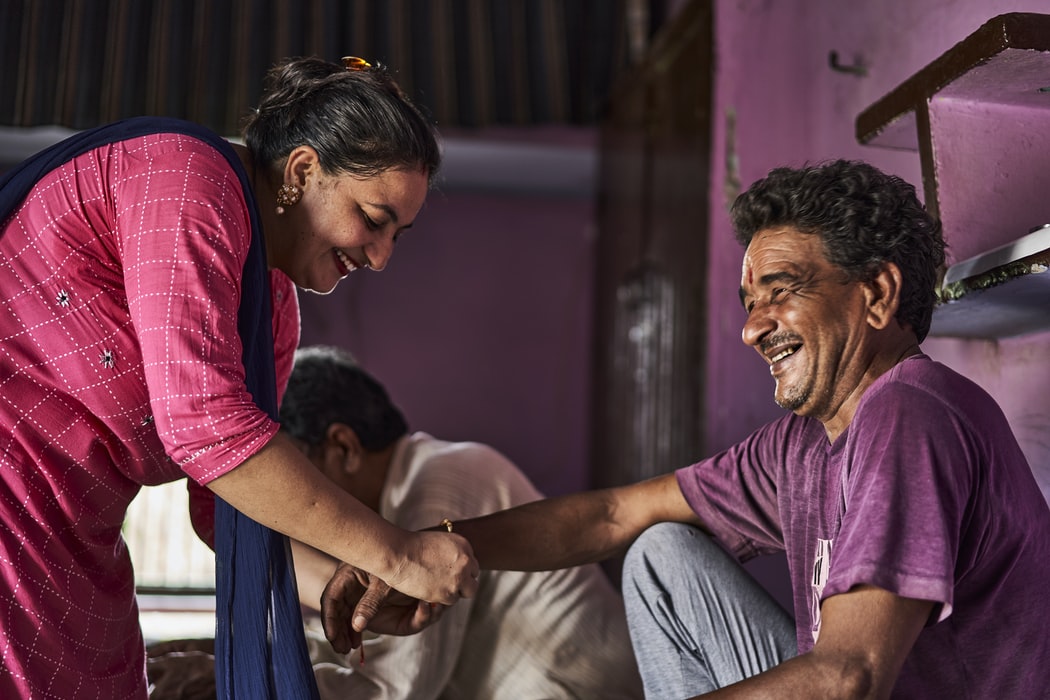
Rakhi Celebrations : From Behavioral Lens

हाम्रो संस्कृतिमा आजको दिन रक्षा बन्धन मनाउंछौ, यो “राखी” भनेर किन अरुको संस्कृतिमा हामी अन्धभक्त भएर पछि लाग्न खोज्दै छौं ?

Translation: In our culture, we celebrate Raksha Bandhan, why are we blindly following others’ culture with the name of “Rakhi”?

After some mindless scrolling of my news feed enjoying my dark-textured black tea, this particular post made me stop, re-read it, and think.

If you do not know about this festival, click here.

To be fair, I have witnessed a lot of “Rakhi” celebrations and pictures in my social media (mostly on my facebook, twitter & instagram) today. It seemed like the people celebrating “Rakhi” and tying the thread to their respective brother(s) this year were in larger quantity than in the past years. I wouldn’t want to deep dive into religious history and cultural accounts about this festival because foremost, I’m not an expert in these matters; and second, my interest is more drawn by the human behavioral aspect of this “increasing” tendency of “Rakhi” celebration. So why do people adopt this foreign culture?

Turns out, it’s basic human behavior.

ZOOMING OUT

As Zalmy (2017) writes in his opinion, festivals – in general – act like stress relievers and help us balance our emotions. Festivals provide us with the opportunity to come together with family, relatives, and friends together in a bond of love. Phelps (2016)’s article published on FestivalMag supports this argument by saying that festivals could help reduce stress levels.

Rakhi” is the celebration between siblings. Researches have shown that bonding with siblings act as a hidden resource in therapy. A research article published by Lewis in 1990 in Journal of Strategic and Systemic Therapies concludes with clinical examples describing three ways to involve siblings in therapy: as participants, consultants, and mutual nurturers. A logical conclusion here is that the “Rakhi” festival, which celebrates this therapeutic experiences through bonding, is justified across all cultures, not just to any one particularly.

Another research article published by Cicirelli in 1989 in Psychology and Aging has come to a finding that closeness of the bond to a sister (by both men and women) was related to less depression.

ZOOMING IN

There’s a famous dialog from the movie Red Sparrow, “Every human being is a puzzle of need. You must become the missing piece, and they will tell you anything.

Whatever any particular person thinks, feels, and does is the reflection of his/her needs being either met or unmet. And as Dr. Marshall Rosenberg quotes, “When we are in contact with our feelings and needs, we humans no longer make good slaves and underlings.

When we are in contact with our feelings and needs, we humans no longer make good slaves and underlings.

– Dr. Marshall B. Rosenberg, Non-Violent Communication: A Language of Life

To better understand the human needs, we can either look inside the “Needs Inventory” of The Center for Non Violent Communication (CNVC) or Max-Neef’s classification of fundamental human needs.

My older article on the pandemic and human behavior was based on the fundamental needs. The COVID-19 pandemic has caused few fundamental human needs to be unmet – especially the need for recreation (leisure), need for affiliation, affection, and connection.

SO?

So, the increased number of “Rakhi” celebrations can be accredited to the fulfillment of these needs. People needed to have fun after the 100+ days of lockdown. They needed to feel connected on a different way with their siblings, because the bonding eventually contributes to a better mental-health and overall well-being.

To overcome this need for recreation and connection, people blended in the “foreign” culture with their own. One can’t really point fingers at anyone.

If you’re wondering why do people “under-value” our own cultural practices, then a quick answer to that would be “Path of Least Resistance (or Principle of Least Effort)“, and I will explain it in my next article. Stay tuned!

Update: Read the Principle of Least Effort article up here.

Don’t Be Yourself; Consider Adaptive Authenticity

“Be yourself. Everyone else is taken.”

This Oscar Wilde’s quote is a common career/life advice most self-help gurus give in today’s context, where ‘authenticity’ has been more of a buzz-word. Before pointing fingers, I’ll admit myself first – I have given this advice plenty times in the past.

However, I needed to overcome my own confirmation bias, and thus, I was determined to look beyond the obvious for this small self-help sentence of being authentic. Borrowing words from Simon Feldman’s book, Against Authenticity, he writes, “Being yourself – this ubiquitous dictum seems like a marvelous philosophical wisdom, but also an empty truism“.

WHAT’S THE PROBLEM WITH AUTHENTICITY?

A lot has been talked about being yourself and having authenticity. There also has been scholarly articles and podcasts about authenticity being a double-edged sword, but most of us choose to willfully ignore it possibly due to our own cognitive biases. In general, these articles talk about how people misuse “being oneself” to justify their selfish actions and behaviors (in short, being a jerk).

You can’t show up in boxers for a job interview, and say “I’m being myself”, can you?

Also, most humans have lost their own credibility when they stick to their own definitions and boundaries of “authentic” personality. People also use authenticity as an excuse to not stretch and grow, or explore more of their own capabilities.

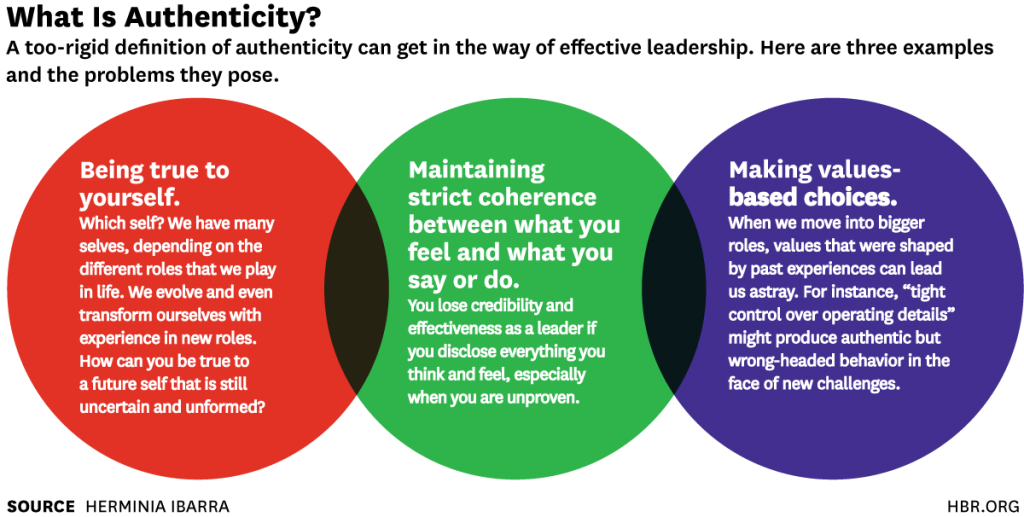
Professor Herminia Ibarra’s research (also published in HBR Article, “The Authenticity Paradox”) suggests that when people are promoted and have a fixed mindset to their own boundaries of being authentic, they would be at greater risk of failing in their new role. Authenticity generally revolves around the triad of i) being true to yourself, ii) maintaining strict coherence between what you feel and what you say/do, and iii) Making value-based choices. However, Professor Ibarra also states a too-rigid definition of authenticity can create problems than do good. Here’s how:

Having a too-fixed definition of authenticity can cause more problems.

“Being yourself” isn’t necessarily a bad advice. But it does turn bad when this is just pasted out of context. This doesn’t really tell us what to do exactly. This ambiguity itself might be a narrative for starting a snowball effect, thereby causing larger problems.

HERE’S SOMETHING TO CONSIDER…

Organizational psychologist Adam Grant vouches about authenticity being a double-edged sword in his podcast. Grant articulates that being authentic without boundaries, status, and empathy would be non-valuable.

I’ve myself realized – especially at times of workshops & trainings – that just “being myself” didn’t work in fostering the connections between me and my audience. I needed to “be one of them”, whilst not losing a major portion of my authenticity. I had to customize myself to be one of them, speak their language, articulate in a way they could comprehend, without having to completely sacrificing my own-self. This is what I prefer to call “adaptive authenticity“.

We need to understand that being ourselves with everyone we meet and disclosing too much of our thoughts and feelings to everyone would be a credibility-killer. Being aware, and adapting to the people and environment and customizing our own actions and behaviors could be a point to start with.

Furthermore, without earning a “status”, our authentic self might not be appreciated. Research have shown a dark side of authenticity in organizational life – it’s only as you progress up the career ladder that you have the license, power and opportunity to be authentic. It takes time for people to earn “idiosyncrasy credits”. Idiosyncrasy credits are what allows us to deviate from group opinions, but a negative credit balance means being our authentic-self might not be appreciated.

Without a qualm, empathy is a big component in being our own authentic self. We can consider asking ourselves a simple question, “How does my actions (resulting from me being myself) affect the other person?” But before all these talks of “being authentic”, we need to look into ourselves, for a detailed self-assessment and self-awareness.To begin with, I would vouch people to listen to Socrates’ advice of “Know Thyself“, and then only go to Oscar Wilde’s advice of “Be Yourself“.

Will We Be Able To Trust People The Same Way?

The COVID-19 global pandemic caused by novel coronavirus has already impacted the world in a much adverse way. From causing global lockdowns to changes in human behavior, the virus has managed to make us rethink the way we act, work, and overall live our life.

The World Health Organization (WHO) has recommended social distancing as one of the most effective ways to decelerate the spread rate. This has already imperiled one of the primary needs of human beings – physical touch and intimacy. One of other major concerns revolves around the question, “Will we be able to trust people the same way?”

Let’s dissect.

It is completely normal for humans to question a new environment, situation, event, object, or another human being. This is because the new environment comes with uncertainty, which jeopardizes our needs for control and sense of security. And not only new people, the skepticism grows towards known people, who have come in contact with unknown environments, too. With this scenario in mind, the surficial answer to the question reaches to “NO!”, but there is more to this picture.

HOW DO WE TRUST?

Jack Zenger and Joseph Folkman write about the 3 elements of trust – positive relationships, good judgement/expertise, and consistency. Positive relationships are about balancing results with concern for others, generating cooperation between others, resolving conflicts, and giving honest feedback in a helpful way. Good judgement and expertise is about anticipating and responding quickly to problems, using knowledge and expertise to achieve results, and even others seeking after their opinions. Finally, consistency is about walking the talk, honoring commitments, keeping promises, and willing to go above and beyond the regular call of duty.

Frances Frei’s TED Talk also gives a similar three elements of trust, viz. the trust triangle – authenticity (I experience the real you), empathy (I believe you care about me and my success), and logic (I know you can do it; your reasoning and judgement are sound).

Professor Dan Ariely in his paper, The Trust Factory, explains about five different trust generators – i) The long game: established relationships, ii) The glass door: transparency, iii) The why factor: intentionality, iv) The counterpunch: revenge, and finally v) The common goal: aligned incentives.

In simple words, he explains these five trust generators as:

i) With consistent partners, people are more trusting.
ii) We are more comfortable when we can see what’s going on behind the scenes.
iii) We are judged less harshly if we suffer as we struggle with moral dilemmas.
iv) The possibility of punishment helps us avoid relationships in which one side is more vulnerable than the other.
v) Sacrificing some income for the benefit of the other party can be an incredibly powerful act.

WHAT DOES THIS TELL ABOUT TRUST?

Simply put, a lot of factors affect whether we trust or do not trust another person, organization, object, or a situation. Summarizing these different literatures, I firmly believe trust comes from consistent acts demonstrating genuine concern for others, keeping others’ best interests at heart, and logical actions with transparent intentions.

Trust Framework

SO, WILL WE BE ABLE TO TRUST OTHERS?

In the worst case, we will see everyone with the same lens – “Could s/he be the carrier of the virus?” We might be skeptical towards the family member who has been in three different meetings throughout the day. We will certainly raise an eyebrow on that customer who looks ill and is continuously coughing without covering their mouth. We might even hesitate to shake hands with a new colleague who just joined the work today.

But the point is that all these do not necessarily stop us from trusting people ever again. Yes, we will be cautious and aware. We will change our behaviors in pursuit to co-exist with the virus. But we will not stop trusting people altogether. The key lies in how we communicate with people. The messages we are sending across needs to mention that we are genuinely concerned for them, have their best interest at heart, and act logically with transparent intentions. We need to recognize the other person’s dilemma, and also need to explain ours.

This might sound absurd at the beginning but certain changes are bound to happen, and happen for the overall good.

Physical Touch: Will we lose it post COVID-19?

Touchwood, let’s hope the pandemic fades quick.

While Noor Tasnim from Duke Global Health Institute was expected to stay in Guatemala for eight weeks, she worried if she would ever fit in. Her advisor, Dr. David Boyd, recommended her to greet every stranger she walked by. Noor goes on to write in her news article that by acknowledging others in the community and having that acknowledgement reciprocated, she felt connected to the locals. Little did she know that such a common greeting could be so powerful.

This makes us wonder, “how do we generally greet our friends, family, or loved ones?” It has mostly been a hug, handshake, fist bump, shoulder bump, or a kiss. Sometimes, just a smile from distance works too. Mostly, the physical touch is important.

THE HUMAN TOUCH

Dacher Keltner, Ph.D. – the founding director of the Greater Good Science Center and a professor of psychology at the University of California, Berkeley – writes that everyday incidental gestures such as pat on the back, or caress of the arm are our primary language of compassion, and a primary means for spreading compassion. In his article published in September 2010, he explains that “to touch is to give life”.

Furthermore, in this journal article published by French physiologist Nicolas Guéguen, he instructed the professor of a 120-person statistics class to give the same verbal encouragement to any student who volunteered to solve a problem at the front of his classroom. But to a randomly selected group of students within the class, the professor also gave a slight tap on the upper arm when speaking to them. Guéguen compared the volunteer rate of those who were touched to those who were not, and found that students who were touched were significantly more likely to volunteer again. In fact, roughly 28 percent of those who were touched volunteered again, compared with about nine percent of those who were not. This demonstrates the positive effect of touch in schools, and how important touch is in communicating positive emotions.

Even in business meetings, handshakes are considered an important part. In a working paper published by Harvard Business School, Juliana Schroeder and Jane Risen of University of Chicago, and Francesca Gino and Michael I. Norton of Harvard University conducted four different studies. These four different studies revealed that handshakes made people feel comfortable initiating negotiations, led to increased cooperative behaviors, obtained higher joint outcomes, crafted more agreements, and in together promoted the adoption of cooperative strategies and influenced negotiation outcomes.

A DIFFICULT PREDICAMENT

While personal touch and intimacy itself is one of the basic human needs, coronavirus hits hard at this very basic human need. Preventing the spread of coronavirus requires hand washing and social distancing. Those are the basics – wash your hands with soap water for at least 20 seconds regularly, and maintaining social distance. As Harvard Medical School elaborates the term social distancing it goes like, “For an individual, it refers to maintaining enough distance (6 feet or more) between yourself and another person to avoid getting infected or infecting someone else.”

This could be the biggest behavioral shift and a major problem for humans, in general.

MIT Technology Review’s editor in chief, Gideon Lichfield, advocates in his article that we are not going back to normal, and social distancing could itself be the new normal – upending our way of life, in some ways forever. Peter Hall – the Professor of School of Public Health and Health Systems at University of Waterloo – advocates in his article published in World Economic Forum that the vaccine will eventually arrive, but in the meantime, epidemics like COVID-19 can be prevented by increasing the prevalence of precautionary behaviors in the general population that impede its spread.

In similar lines, the BBC Future also predicts that we – humans – will be less touchy-feely and far more wary, and the transition will feel strange. It also goes on to say that we may find ourselves more comfortable with keeping people at a distance from us when we greet them.

A RAY OF HOPE?

The Independent newspaper published an article back in 2015 stating that handshakes during business negotiations work even when one of the parties involved is a robot.

A scientific study found that when two people who may be located thousands of miles apart communicate through a robot, shaking hands with the machine and communicating the physical act still encouraged co-operation and mutual understanding.

As per the research team, even though the handshake was virtual, it created a sense of connectedness between both people as they experienced the sensation of grasping a hand with a vibration generated through a controller. They further go on to mention that the findings could provoke a revolution in the art of conducting a video conference or Skype interview.

Also Read: Will we be able to trust people the same way?

Robin Dunbar, emeritus professor of evolutionary psychology at Oxford University, goes on to say that physical contact is a part of the mechanism we use to set up our relationships, friendships, and family memberships. As published in this BBC Future article, Dunbar has some words of hope. “Touch is not the only mechanism used for physical bonding,” he says. Evolution from our primate progenitors has given us new ways to feel a connection with others that also trigger endorphins. “They’re things like laughter, singing, dancing, telling stories, religious rituals and so on,” he says – “the things we use in our everyday social interactions.”

While we might remain more cautious about physical contact for the time being, physical – or – social distance doesn’t really mean we can’t feel close.

COVID-19 Pandemic & Human Behavior

This lockdown has given me ample time to reflect back not just on my own thoughts, feelings and behaviors, but also understand the general human behavior as a whole. While most of the stated behavior looks obvious and nothing new, that is where the point in writing this article lies. Humans tend to overlook “obvious”, as defined by the psychology of willful ignorance or blindness.

In her book, Willful Blindness: Why We Ignore the Obvious at Our Peril, Margaret Heffernan explains the concept of willful blindness in context of legal system as:

It refers to a situation where — if an individual could have and should have known something, then the law treats it as if he knew it. The claim of not knowing isn’t a sufficient defense. Heffernan notes: “The law doesn’t care why you remain ignorant, only that you do.”

Also Read: Why are we so confused?

This basic and obvious understanding of human behavior is crucial to understand other people better, and therefore, manage personal and professional relationships better.

For ease of understanding and segregation, the general behaviors are divided according to fundamental human needs. A small, but important disclaimer is required here, because these common human behaviors are generalized (and definitely NOT stereotyped) on my limited viewpoint and assumptions only.

On Subsistence:

This is the need for survival, safety, security, and control. Humans are seeking to be more financially secure by postponing big-purchase decisions. They have this economic pressure of paying rent, day-to-day groceries, medications, and also have to keep aside a contingent reserve for future uncertainties. People are focusing largely on health and sanitation. Job security has become a large concern, especially with the lockdown crippling the economy. People have the fear of losing their job, or receiving a pay-cut, or furlough.

Given that humans generally want certainty and prefer to take control over situations, some people have stocked (or even hoarded) resources needed for survival. This need for control and certainty has triggered a horrific and disgusting face of humans – they want to eliminate outside threats. In pursuit to eliminate the threats, some people have taken extreme irrational measures – taking down bridges connecting two districts, blocking road access, or even xenophobic remarks and death threats to the coronavirus positive patient.

On Self Care & Recreation:

For self-care, people have not been able to go to gym work-outs or even their regular futsal games. People have opted to perform home-based exercises even with limited resources. Some people have started self-care in form of yoga and meditations, which is definitely one of many positive takeaways from the lockdown. People’s leisure and recreational needs in terms of traveling and exploring new places is hampered the most. To overcome this, people have resorted to cooking new recipes, Netflix and other on-demand video streams, and even playing online and offline games with friends and family.

On Understanding & Growth:

Humans have this need for acquiring knowledge, comprehending the knowledge, and applying the understood knowledge for greater wisdom. People have learnt new recipes, read new books, explored themselves, and gathered new facts and information about various subject matters. People also have taken this lockdown time for enrolling in various online free courses and participating in webinars. These would – hopefully – expedite their mastery and growth over the subject matter of their interest.

For the working population, few of their works are now being done from home. This has triggered the need to teach themselves with technology usage. Use of internet, web-based software, video-conferencing, and online collaboration are probably at all time high. The late majority and laggards (as defined in the Diffusion of Innovation Curve) are now finally adopting the remote and virtual way of working.

However, on the flip side of consuming information comes misleading and fake news that quickly spreads around the social networks. The lack of people verifying the authenticity and credibility of such misleading and fake information seems to be a major threat for the community as a whole. To combat these, fact-checking sites such as Nepal Fact Check have also evolved rapidly during the lockdown.

On Connection & Love:

Humans crave for connection, love, belongingness, care, acceptance, and even touch and physical contact. The lockdown period has definitely brought some people close to their family as a result of being at home all the time. On the flipside, some people (especially migrant workers) are stuck in foreign countries and are dying to come back home. Some people have swam across the Mahakali river to get back to their motherland. Some people have adventured numerous days’ journey on foot to go back home, be it in hope or despair.

To keep up with peers, friends, and colleagues, people have started various “challenges” in social media apart from regular video calls. From posting pictures clad in beautiful sarees, to reminiscing when they first met together, people have craved for connection. Dalgona coffee, Instagram Bingos are just other examples which state the obvious – people do crave for connection.

With the nature of the coronavirus itself, the touch and physical contact are at the threat. Being forced to isolate and maintain a distance, some people will have a hard time keeping their hands off their loved ones. I’m assuming the hug to your loved one(s) after lockdown ends (and hopefully the pandemic ends too) is going to be a very special one.

People are working from home to keep up with their work, but this has also impacted the need for love and connection from their family members. For some people working from home, they have found themselves working for more hours, stressing more, and eventually exhausting themselves more. This culture is making some people’s life hard in terms of managing their work, family, and self.

On Creation & Contribution:

While humans crave for love and care, they also have this need for creating something, contributing to others, serving people and community, and making the world around us better.

People are using all local resources available for keeping things on-going. There have been wonderful examples of COVID testing booths being made in Nepal with locally available resources, the Personnel Protective Equipment (PPE) being stitched locally and distributed without any charges, and so on. Brands have collaborated together to make daily groceries and necessary equipment available to their doorsteps at this time of crisis. Businesses are being creative with alternate services and products and thus, generating sources for sustaining.

People are fulfilling this need to give and do for others (contribution) by helping the daily wage earners, collecting funds, assisting them with relief items, and so on. This demonstrates the empathy humans have within ourselves. However, the question still remains at large about empathy when it comes to treating COVID affected people as criminals.

On Identity & Purpose:

During this time of crisis, people’s need for recognition, status, identity, significance, and purpose have largely been secondary. This could primarily be because of human beings’ need for survival is larger than identity and purpose in this time of crisis. However, I have seen some circumstances where some people have been reinforcing their identity via social networks, as well as some people realizing new found identity as well as purpose of life, during this time of crisis.

These were the basic human behaviors that I managed to identify with my own set of observations. I’m sure I have missed out a lot. Help me complete it by making me aware of it.